
Artist of the Month

June Artist: Andy Smith
Opening Reception: Saturday May 30th 5-7pm
I have been a potter sice 1976/ It became my full-time occupation in 1982. And I have loved every minute of it. My home and studio are located in Marshville, NC. Architecture was my first love, and creating pottery allowed me to design every day. Clay is so addicting and learning something different about it makes my work exciting and always new.
I have always worked with raku. Discovering the many permutations of that is what makes my work distinctive; from traditional, to smoked, and saggar. It is a pleasure to share with everyone.


July Artist: Kelly Long
Opening Reception: Saturday, June 27th 5-7pm
Most of my work is decorative in nature. My pieces are handbuilt using red earthenware clay
and glazed using an ancient technique called terra sigillata. I use handmade stamps as well as
my great-grandmother’s lace doilies to give my pieces movement and texture.
The reason texture is so important to me is the same reason that I’m drawn to pottery as a
medium. Beyond the aesthetic appeal, it serves a function. I have a visually impaired daughter
and I worked at an afterschool program for visually impaired children. A couple years ago, we
went to the Bechtler Museum and took a tour. The children were allowed (and encouraged) to
touch several of the pieces in the museum. I realized that through touch, they were able to
experience the art. I want my pieces to be the same – I want people to experience my work
through sight and touch.


August Artist: Sylvia Coppola
Opening Reception: Saturday, July 25th 5-7pm
After 50 years of working in clay, I still find it intriguing. There is always a different way of creating and firing, a new form to work on and different glazes to test and mix. My earthy palette of glazes show my connection to nature.
Duck Creek Pottery is located in the country where my Father’s homeplace was and my ancestry goes back to the early 1800’s. I feel connected to my surroundings and it is apparent in my clay work. Most of my forms are created on the wheel but some are hand formed using slabs of clay.
It is a pleasure to create pottery from clay and have people use it in their homes on a daily basis.
My work has been sold across the US and has been shipped to many countries across the world.


September Artist: Sasha Bakarik and Ronan Peterson
Sasha Bakaric: My inspiration comes from microscopic images of various cells and microorganisms as the
basis of all life. I am intrigued by dichotomy between the enormous beauty of these images
and the fears or repulsiveness that people often have when faced with viruses or bacteria.
I love the idea of questioning our relationship with the world inside of us. In the same way
as microorganisms are multiplying and spreading, so are my pieces. I find great excitement
in making yet another similar but totally unique piece.
Ronan Peterson: Essentially, I am dealing with effects of agents of growth and decay and how these agents shape and embellish the surfaces of stones and the skins of trees. These agents also serve key roles in interacting with my ceramic vessels. Mushrooms, seed pods, grubs and other growths serve as knobs and handles, allowing one to remove lids and discover what might be inside or underneath a covered vessel, like lifting a rock to have insects scurry in many different directions when subjected to the light of day. The vessels are not intended to be actual representations of the trees and rocks, but abstractions and stylizations of these natural phenomena. Employing an earthy background palette stretched across textured but quieter surfaces, I wanted to upset that quiet earthiness with intense splashes of vibrant color, patterns, and glossy surfaces not commonly associated with tree bark or the rough surfaces of rocks amidst fallen leaves. I am interested in inflated volume and thick line qualities that reference comic style drawings and how that can apply to interpreting the natural world. With my ceramic vessels I hope to create a comic book interpretation of the natural world with a focus on the rocks and trees and their role in the perpetual organic comedy of growth and decay. Recently, I have turned to abstract paintings for ideas and inspiration, and definitely delve more into the imagined and extra-terrestrial speculations that float in and out of my mind.
Sasha Bakaric and Ronan Peterson


October Artists: Tim Moran and Janet Gaddy
Gorgeous crystals are grown inside the glaze during a complicated firing schedule. The entire 10-step process can take up to 30 hours for a single piece. Even with great care the failure rate is high. Therefore only a few potters have accepted the challenges of crystalline pottery.
Crystal glazes require an intricate long cooling schedule. The zinc based glazes run off the pot and need special containers to collect the melted glaze. It is impossible to repeat the design on any piece; therefore each pot is very unique. The crystals actually form in the glaze in a chemical reaction during cooling and grow from small nuclei created during the melting process when silica and zinc come together to form zinc-silicate.
The crystal glazed ware is fired to approximately 2340℉, and then held in the kiln for cooling between 2000℉ and 1830℉ for 3 to 5 hours depending on the glaze. When finished, the piece is removed with a chisel and mallet from its base and grinded smooth. Each piece is created using high fire fine porcelain.


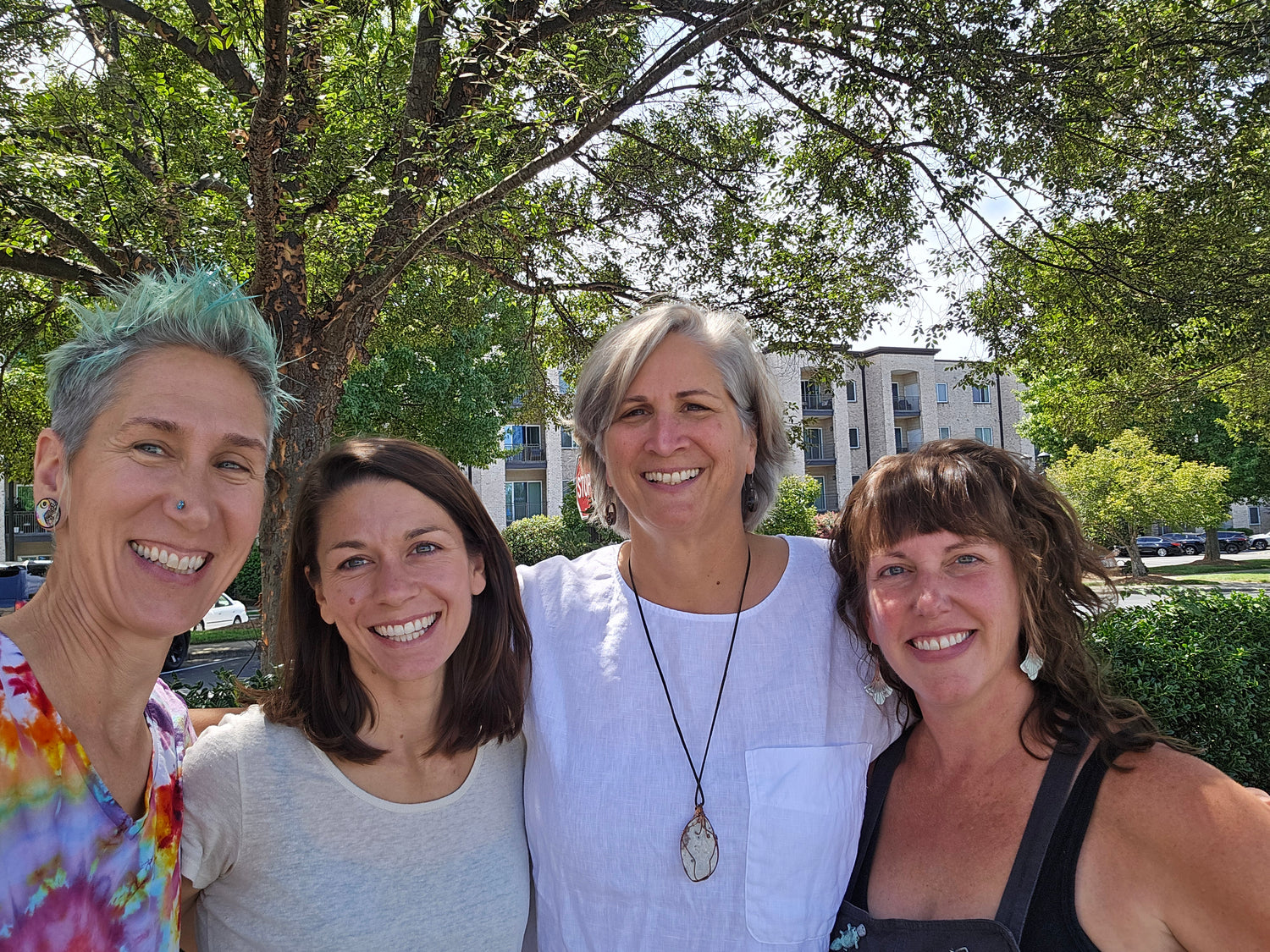
Venus Collective
From left to right:
Megan Lassen, Emily Flores, Jennifer Harkey, and Annie Grimes Williams
The Venus Collective, a group of North Carolinian women artists, aims to support and foster the development and growth of the members through networking, teaching, and inspiring each other toward the vision of artistic exploration and self expression with the goal of connecting the group’s communities through the language of art.
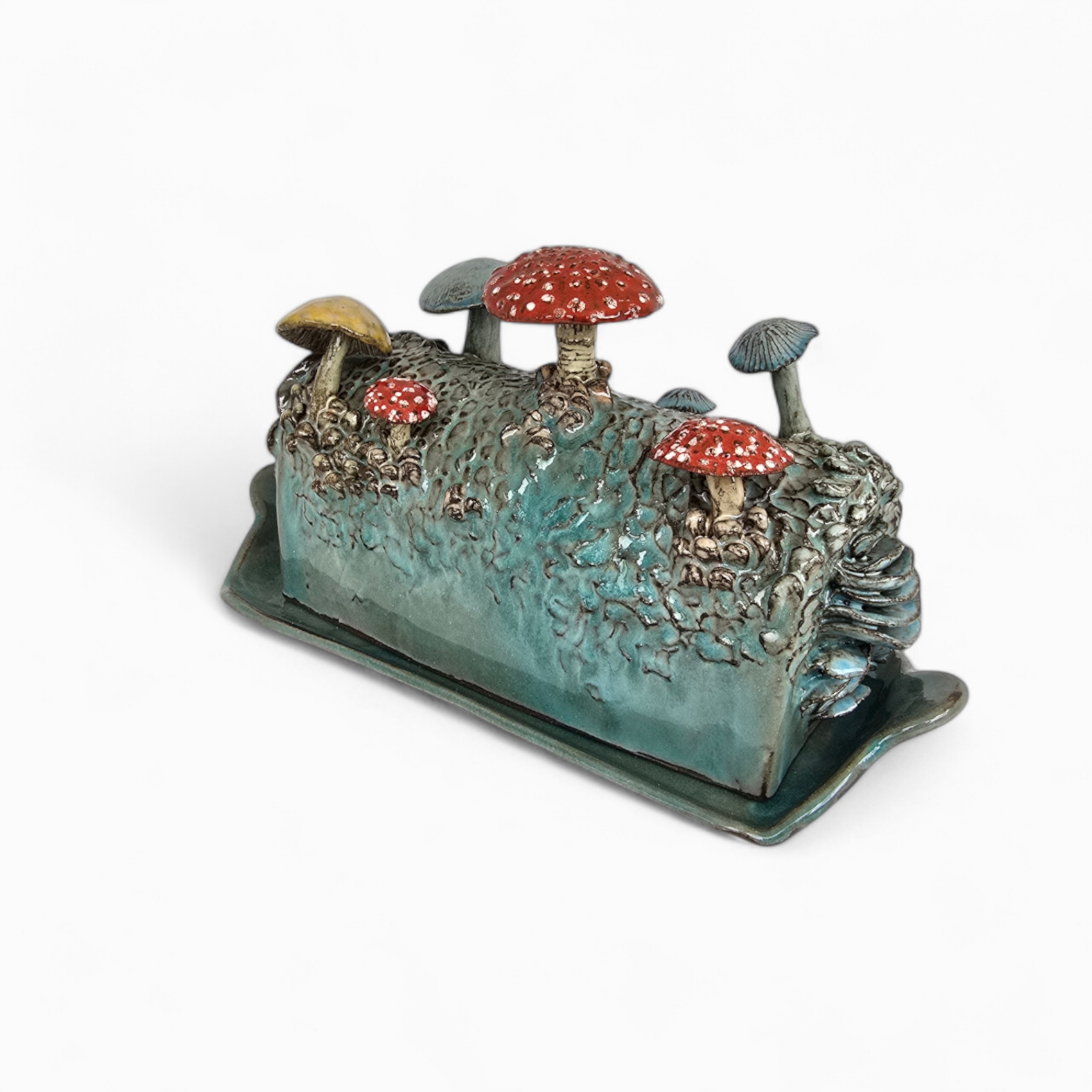
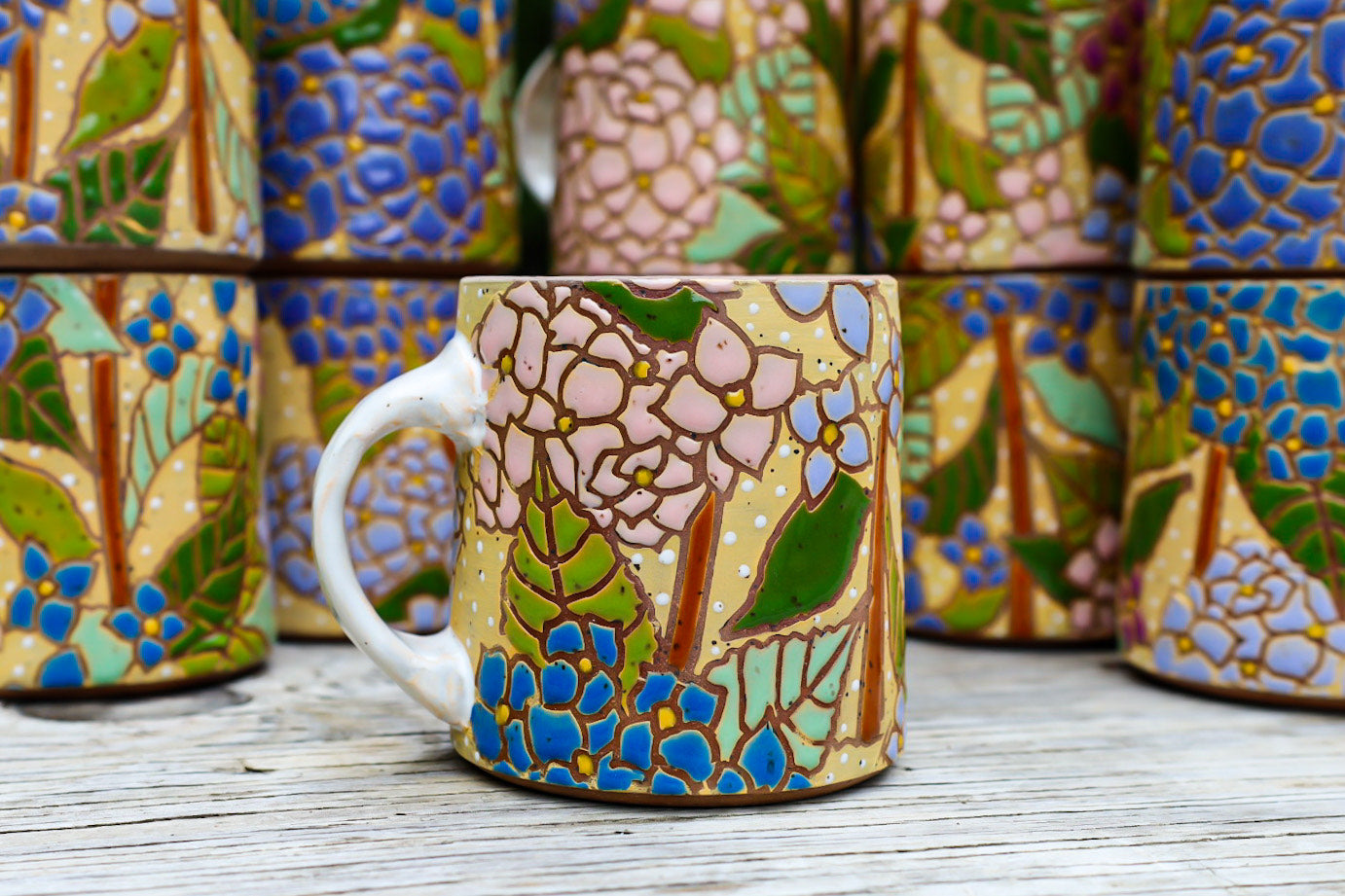
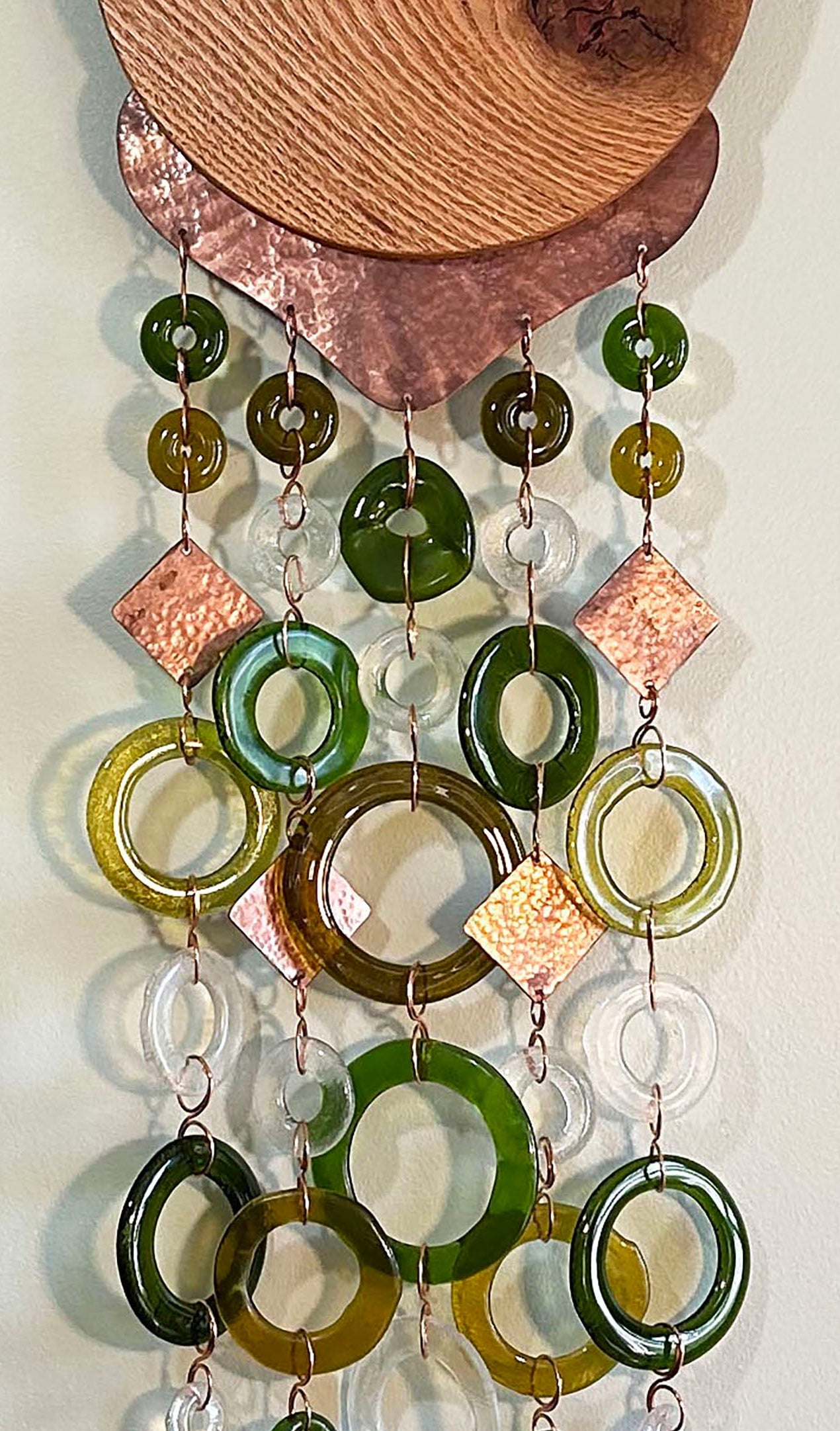
Interested in Becoming One of Our Featured Artists?
Email us your contact information, 5-10 images of your work, an artist statement, and a headshot for jury review.

January Artist: Dawn Hummer
Opening Reception: Saturday January 3rd, 5-7pm
Wildflower Woven Design celebrates the mindful and time intensive creation of one-of-a-kind finely woven art pieces for home, public and personal adornment. With respect to traditional patterns and techniques from both eastern and western culture, each piece evolves in my studio as sculptural fiber art. Aesthetic principles of asymmetry, simplicity and wabi-sabi, fused with whimsical deconstruction in design and process are joyful and identifiable statements within each woven piece.
Woven pieces begin with a single hand-warped fiber sequence of 100’s of sustainable and often hand-dyed textural threads meticulously threaded beamed on a multiple harness floor loom. Foot-treadled patterns combined with shuttles of weft advance the hand-manipulated design in a fusion of color and texture. Sustainable warp and weft fibers include linen, silk, bamboo, wool, alpaca, tencel, cotton, hemp and sugarcane as well as metals, paper, 16mm film, and found materials.
Woven basketry and Hand-Dyed hooked wool vignettes on linen convey traditional techniques in basketweaving and hooking, using sustainable reed, cane and wool. Traditional woven techniques or painterly colorful hand manipulations are used to create joyful, colorful and textural one of a kind statement pieces in function or design.


February Artist: Deborah Harris
A Special, Double Feature Opening Reception: Saturday February 28th, 5-7pm
Handcrafted pottery serves an intimate connection between user and artist. Objects handled during everyday routines become familiar and comfortable. My hope is that every piece I create will be utilized and enjoyed.
The majority of my work is wheel thrown porcelain. The pots are decorated by brushing black slip onto the leather hard clay and then carved with a variety of tools. This sgraffito technique adds subtle texture exposing the raw white porcelain. The celadon glaze used on many of these pieces gets the soft blue/green color from trace amounts of iron in the formula. After firing, porcelain becomes translucent to light and rings when gently tapped. These unique properties drew me to work almost exclusively with this claybody.
Early use of porcelain dates back to the 12th century Song Dynasty. The beauty of the black and white ware along with the celadon glazes from the Cizhou kilns of this time period have been a strong influence.The designs express the natural and mythical world with insects, plants and dragons. This is such a rich source of inspiration and motivation. The use of Ginkgo leaves also draws on historic references. The Ginkgo tree is a symbol of strength, longevity and considered a living fossil as one of the oldest tree forms. In addition to their endurance over millennium, Ginkgos have survived the devastating atomic bombings of WW II. This has me considering, where will the shards of my pots be in 1,000 years? I wonder with every tea bowl I throw.


March Artist: Maria Frey
A Special, Double Feature Opening Reception: Saturday February 28th, 5-7pm
Maria Frey is a full-time studio potter and clay educator working within the rich tradition of pottery in her home state of North Carolina. In 2023, Maria embarked on a journey to build her own atmospheric kiln from the ground up in order to explore and embrace the wild possibilities of surface through soda firing. Focused mainly on functional ceramics and decor, Maria's work comprises both wheel thrown and hand-built forms which seek to record a moment in time where the artist and material met. As artist and educator, her work aims to display how clay and life are continually shaped and formed for something more helpful, more enjoyable, and more intentional.
My studio practice celebrates the artistry and craft of clay. I produce high fired stoneware pottery finished in a gas soda kiln that I built myself. I love to spend time refining details of form and decoration before the pots enter the kiln, then let its atmosphere of soda vapor and flame dictate the rest. Working this way forces me to collaborate with uncertainty, to give way to the elements of chance and change, and to accept the results that I can’t totally control but am guided and inspired by.


April Artist: Joy Tanner
Opening Reception: Saturday March 28th 5-7pm
While I pay equal attention to form, surface, and detail, my pottery is most noted for its carved patterns inspired by nature. I am just as interested in the way a leaf connects to its stem as I am the folds of a mountain range or bursts of color at sunrise. These reflections I find in nature weave their way into the surfaces of my pots, and accrue a rhythm all their own as they swirl and drape across surfaces, suggesting spider webs, ripples in a stream, or water patterns in sand. Through my regular yoga and meditation practice I have become quite interested with the connection between our body and mind and the forms I create out of clay, or the inspirations I find in nature. Often it feels like the form of the pot swells with breath, like my body in certain yoga poses, or my jar knobs resemble hands reaching up in a sun salutation. The bones of the body, such as the rib cage, resemble the patterned lines and edges that drape over the form of the pot.
My work reflects an awareness of the present moment, resulting in uniquely designed pottery that is just as inviting to ponder and touch as it is to use and share. Firing my stoneware forms in a soda kiln or a wood kiln yields an ever changing palette of natural variations of color. Cradling a cup or bowl in their hands, people feel inspired to bring a sense of awareness and ritual into their lives. Integrating the way I experience the world with the way I design my pottery is essential to my creativity. Whether rinsing garden tomatoes at the kitchen sink, or pausing to study wildflowers along the trail, I believe in taking time to notice the little details of life.


May Artist: Cathy Cooper
Opening Reception: Saturday April 18th 5-7pm
Rooted in the traditions of Western North Carolina, my vessels are crafted primarily from wild, local clays. Growing up in the Piedmont, I was shaped by family rituals—Sunday dinner tables set with linen, heirloom china, and Grandma Margaret’s pies served in fluted Seagrove pottery.
When I turn clay, I feel that connection to the past. From butter churns to whiskey jugs, North Carolina pottery has always been part of my life.
Some of my recent work features Legendary James Bottom Clay, generously shared by Preston Tolbert and sustainably harvested through the Foothills Conservancy of North Carolina. This historically rich material—once used by master potters like Burlon Craig—has been revived thanks to our community, including Matt Hallyburton and Kim Ellington. Working with it adds depth and meaning to my practice, honoring the enduring spirit of Catawba Valley pottery.
I primarily soda fire my work, a process where flame and vapor create unpredictable textures and earthy hues. Each piece becomes a canvas for atmospheric transformation—raw, elemental, and impossible to replicate.
I’m grateful to be part of a community that celebrates this craft. It brings me joy to know my work might become part of someone else’s story—creating new memories in homes near and far.
Each pot is made to be cherished, passed down, and remembered. My hope is that when someone holds one of my pieces, they feel the care and passion behind it—and that it becomes part of their own traditions, just as Grandma Margaret’s pie plates are part of mine.


